
Вид для чтения

Появились новые статьи. Нажмите, чтобы обновить страницу.

River renaturalization emerges as strategy to combat urban flooding

Logo Agência Brasil

Extreme rainfall and flooding have become increasingly frequent in Brazilian cities. In this context, the renaturalization of urban rivers is one of the strategies experts advocate to help cities adapt to the impacts of climate change. Restoring and reopening waterways can make these areas more resilient.

Urban landscape architect Cecília Herzog, a member of the Network of Experts in Nature Conservation (RECN), says river restoration is an urgent measure given the current climate scenario.

Notícias relacionadas:

According to her, the development model that channeled rivers and covered the soil with asphalt and concrete has exacerbated the effects of rainfall.

“It’s important to remember that water doesn’t disappear. When it rains, it always flows to the lowest points and, at some point, can flood them, especially in flatter or low-lying areas,” Herzog said.

With fewer permeable surfaces, water runs off more quickly, increasing the risk of flooding. In this context, river restoration must be accompanied by a broader revitalization of the urban landscape, including the expansion of green spaces and natural drainage systems. Permeable soil helps slow runoff.

“Water seeps into the soil, is retained for a while, and then continues its course in a more balanced way. In open rivers, with their natural course and riparian vegetation, the impact of rainfall is much smaller,” the landscape architect explained.

Porto Alegre (RS), 20/06/2024 - Moradores em rua alagada pela enchente no município de Eldorado do Sul. Foto: Bruno Peres/Agência BrasilPorto Alegre (RS), 20/06/2024 - Moradores em rua alagada pela enchente no município de Eldorado do Sul. Foto: Bruno Peres/Agência Brasil
With fewer permeable surfaces, water runs off more quickly, increasing the risk of flooding - Bruno Peres/Agência Brasil

Ongoing projects

This understanding is beginning to gain traction in Brazil. In São Paulo, the future Bixiga Municipal Park envisions reopening part of the Bixiga stream, as well as preserving springs and expanding green spaces. The project is the result of more than four decades of mobilization by civil society.

In 2024, the city council approved the allocation of the land for the creation of the public space, and in January this year, the city launched a national public competition to define the design of the future park. The result is expected to be announced in May.

In Rio de Janeiro, a working group coordinated by the Municipal Secretariat for the Environment and Climate is studying the rehabilitation of the Maracanã River through nature-based solutions. Researchers from public and private universities are participating in the initiative.

The proposal includes measures to restore some of the river’s original characteristics and expand the region’s drainage capacity. In March, a partnership was established with the Brazilian Institute of Architects (IAB-RJ) to hold a national public design competition for the renaturalization project. No date has yet been set for the call for proposals, but it is expected to be released later this year.

New standards

Architect and urban planner Juliana Baladelli Ribeiro, project manager at the Boticário Group Foundation, emphasized that renaturalization is part of a new urban development paradigm.

“This concept also includes the implementation of green roofs, rain gardens, vegetated swales, small retention basins, extensive tree planting, and other structures that allow for temporary water retention, facilitate infiltration into the soil, and promote evapotranspiration by plants,” Ribeiro noted.
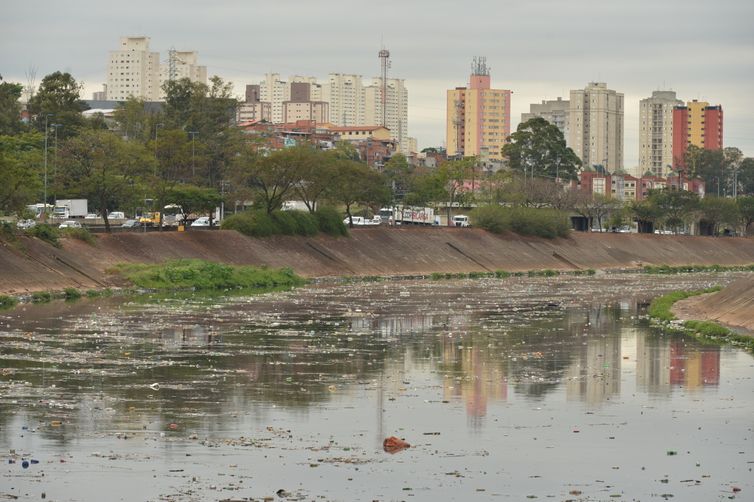
Acúmulo de lixo no rio Tietê, após chuva durante a manhã.Acúmulo de lixo no rio Tietê, após chuva durante a manhã.
The development model that channeled rivers and covered the soil with asphalt and concrete has exacerbated the effects of rainfall - Rovena Rosa/Agência Brasil

In addition to reducing flooding, these solutions also help mitigate heat waves, which are becoming increasingly frequent in cities.

Experts emphasize that isolated measures will not be sufficient in the face of increasingly intense extreme weather events. Climate adaptation requires integrated actions tailored to the reality of each territory.

“It will be necessary to create a system for revitalizing the urban landscape. The idea is to restore to the city areas of living soil and native vegetation capable of performing important ecological functions that are currently compromised,” the architect stated.

“This may include sunken areas designed to collect rainwater and various types of green infrastructure, ranging from small-scale interventions to larger projects, depending on the characteristics of each city. Adapting to climate change is always a local challenge that must be addressed in each specific area,” Herzog added.

Brazil’s population growth slows as aging accelerates

Logo Agência Brasil

Brazil’s population is aging and growing at an increasingly slower rate. This is reflected in the 2025 Continuous National Household Sample Survey (PNAD), released this Friday (Apr. 17) by the Brazilian government’s statistics agency IBGE.

Last year, the country's resident population reached 212.7 million, an increase of 0.39 percent compared to 2024. The growth rate has remained below 0.60 percent since 2021. Of the total, 51.2 percent were women and 48.8 percent were men.

Notícias relacionadas:

The distribution of the population shows a decline in the proportion of people under 40 years of age, a group that was 6.1 percent smaller in 2025 than in 2012. By contrast, the share of older age groups has increased: those aged 40 to 49 rose from 13 percent to 15 percent, those aged 50 to 59 from 10 percent to 11.8 percent, and those aged 60 or older from 11.3 percent to 16.6 percent.

This shift is also evident in the age pyramid: between 2012 and 2025, the base narrowed and the top widened, with a decline in the population aged 39 and under.

Regional differences remain striking. The North and Northeast regions have the highest shares of young people, accounting for 22.6 percent and 19.1 percent of the population aged 13 and under, respectively, while the Southeast and South have higher proportions of older adults, with both regions reporting 18.1 percent of the population aged 60 or older.

There have also been changes in how the population identifies its skin color or race. The number of people identifying as white has declined in all regions of the country. In 2012, whites accounted for 46.4 percent of the population; by 2025, this share had fallen to 42.6 percent. The percentage of people identifying as black rose from 7.4 percent to 10.4 percent.

The North recorded the largest increase in the black population, rising from 8.7 percent to 12.9 percent. The South saw the strongest growth among people of mixed race, from 16.7 percent to 22 percent, and the sharpest decline in the share of those identifying as white, from 78.8 percent to 72.3 percent.

Rise in single-person households

The percentage of people living alone also increased. In 2025, single-person households accounted for 19.7 percent, up from 12.2 percent in 2012. The nuclear family arrangement - defined as a couple, a mother with children, or a father with children - remains the most common, representing 65.6 percent of households. However, this share has declined from 68.4 percent in 2012.

The survey shows age and gender differences among people living alone. Among men, 56.6 percent are between 30 and 59 years old, while among women, the largest share (56.5 percent) is aged 60 or older.

Regarding housing tenure, the proportion of rented properties rose to 23.8 percent, an increase of 5.4 percentage points since 2016. Meanwhile, the share of fully paid-off, owner-occupied homes fell to 60.2 percent, a decline of 6.6 percentage points over the same period.

There was also a shift in housing types: single-family homes still predominate, but their share fell to 82.7 percent, while apartments increased to 17.1 percent.

Human hair barriers placed to contain oil in Rio’s Guanabara Bay

Logo Agência Brasil

Guanabara Bay, in Rio de Janeiro, now features an unprecedented technology for containing pollutants – barriers made from human hair have begun to be installed to absorb oil and retain waste. The initiative was implemented at Bom Jesus Cove, on Fundão Island.

Devices made of rolls of human hair wrapped in cotton mesh were attached to a floating barrier approximately 300 meters long. The structure had been used previously to retain trash and will now also absorb oily pollutants – a vital step forward in protecting the local mangrove forest.

Notícias relacionadas:

Studies indicate that one gram of hair can absorb five gram of oil on average, making it an efficient and low-cost alternative for combating pollution.

The initiative is led by the NGOs Orla Sem Lixo Transforma (OSLT) and Fiotrar, with support from the Boticário Group Foundation for Nature Conservation. This is the first time this technology has been applied in a natural environment in Brazil.

The rolls of human hair are sourced from what would otherwise be discarded by the Fiotrar, which receives donations to produce wigs for cancer patients.

Fiotrar Director Caroline Carvalho says the installation of the barrier validates years of research and development of this technology.

“After a long journey to turn an idea into a practical solution, the fact that we’ve reached this stage proves it is possible to combine science, sustainability, and social impact in a concrete way,” she stated.

Suzana Vinzon, coordinator of Orla Sem Lixo Transforma and professor at the Federal University of Rio de Janeiro (UFRJ), explains that the project underwent a series of tests over the past year, aimed at adapting the technology to the specific environmental conditions of the bay and the structural characteristics of the barriers developed.

The protection of mangroves is considered strategic for the resilience of Guanabara Bay. They function as natural barriers, reducing wave force and protecting the coast against erosion and extreme events. By preventing contamination from oil and trash, the new technology helps preserve these areas, which are also essential for carbon sequestration and the maintenance of biodiversity.

Liziane Alberti, an oceanographer and biodiversity conservation specialist at the Boticário Group Foundation, argues that the initiative demonstrates how different solutions can complement one another to address complex environmental challenges such as marine pollution.

❌