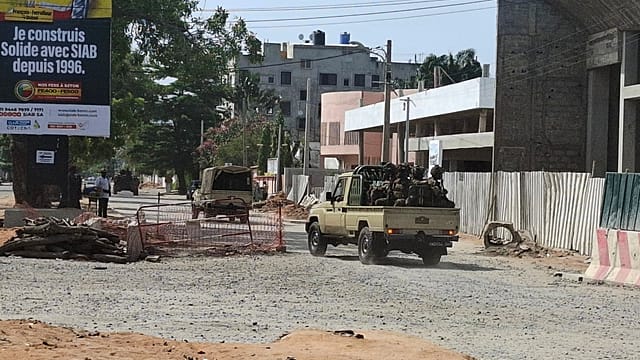
Sudan: Business steadily returns to Khartoum market


In his speech, the President of the European Council, António Costa, said that the signing of the treaty, negotiated over the past 26 years, reaffirms the belief of the member states of both regional blocs in fair trade and multilateralism.
Costa considered that, although it took a long time, the treaty “arrives at an opportune moment […] because this agreement is a bet on openness, exchange, and cooperation, in the face of [threats of] isolation and the use of trade as a geopolitical weapon. […] With it, we do not aspire to create spheres of influence, but rather spheres of shared prosperity, based on trust, cooperation, and respect for the sovereignty of our democracies. We do not intend to dominate or impose, but rather to promote and strengthen the links between our citizens and our companies in order to create wealth sustainably, while protecting the environment and environmental rights.”
The President of the European Commission, Ursula von der Leyen, reinforced Costa’s assessment, saying that the act has the potential to connect continents and create the world’s largest free trade area, with a market of 700 million people.
“We chose fair trade instead of tariffs. We chose long-term partnerships instead of isolation,” said Ursula von der Leyen.
Host of the event, Paraguayan President Santiago Peña highlighted the diplomatic pragmatism necessary to overcome 26 years of deadlock.
“We are facing a truly historic day, long awaited by our peoples, [capable of] uniting two of the most important global markets and demonstrating that the path of dialogue, cooperation, and fraternity is the only way,” Peña emphasized.
He highlighted the commitment of Brazilian President Luiz Inácio Lula da Silva – who, due to scheduling conflicts, could not travel to Asunción – and Ursula von der Leyen to the success of the negotiations. “Without President Lula, perhaps we would not have reached this day. He was one of the key figures responsible for this process.”
The President of Argentina, Javier Milei, emphasized that the agreement constitutes a starting point for the exploration of new commercial opportunities and a basis for greater regional integration, grounded in free trade. According to the Argentine president, promoting macroeconomic stability and ensuring legal predictability are indispensable conditions for prosperity and social justice.
The Uruguayan president, Yamandú Orsi, described the agreement as a “strategic partnership,” capable of improving the lives of the populations of the signatory countries by creating real opportunities. According to him, for Uruguay, it is an “indispensable condition for development,” as well as a platform to confront “threats that do not recognize borders, such as drug trafficking and other transnational illicit practices.”
Representing Brazil, the Minister of Foreign Affairs, Mauro Vieira, reiterated Lula’s statement, according to which the trade agreement between Mercosur and the European Union is proof of the strength of the democratic world and a demonstration of multilateralism. “The agreement will provide tangible gains, more jobs and investment, greater productive integration, expanded access to quality goods and services, technological innovation, and economic growth with social inclusion […] in a world plagued by unpredictability, protectionism, and coercion,” Vieira declared.
The text of the agreement still needs to be submitted for ratification by the European Parliament and the national congresses of each Mercosur member country. Its entry into force, including the trade provisions, depends on this approval.


The figures were released Saturday (Jan. 17), after the treaty was signed by representatives of the European bloc and Mercosur member countries at a ceremony in Asunción, Paraguay. After the signing, the text will still be submitted for ratification by the European Parliament and the national congresses of each Mercosur nation. The confederation believes that the formalization of the agreement is a turning point for Brazilian industry.
“Based on 2024 data, 82.7 percent of Brazil’s exports to the EU will enter the bloc without import tariffs from the outset. On the other hand, Brazil has committed to immediately eliminating tariffs on only 15.1 percent of imports originating in the European Union, reinforcing the favorable difference for the country,” the document says.
Also according to the analysis, Brazil will have eight additional years on average to adapt to the tariff reduction, compared to the European bloc’s deadline and considering bilateral trade and the schedule set out in the Mercosur–EU agreement.
“The signing of the agreement is a historic milestone for strengthening Brazilian industry, diversifying the export basket, and integrating the country into global trade,” says the confederation.
“Under negotiation for more than 25 years, this is the most modern and comprehensive treaty ever negotiated by Mercosur and goes beyond tariff reduction as it incorporates disciplines that increase regulatory predictability, reduce costs, and create a more favorable environment for investment, innovation, and job creation,” the entity goes on to state.
According to CNI, in 2024, for every BRL 1 billion exported from Brazil to the EU, 21,800 jobs were created – generating BRL 441.7 million in wages and BRL 3.2 billion in production.
The compact also has positive results for the agro-industrial sector, as the negotiated quotas favor key sectors and, in the case of beef, are more than double those granted by the European Union to partners such as Canada, and more than four times higher than those allocated to Mexico. Rice quotas exceed the volume currently exported by Brazil to the bloc, expanding the potential for access to the European market.
The signing of the treaty also creates a favorable environment for expanding research and development projects focused on sustainability and technological innovation, CNI reports.
“New regulatory and market requirements are driving opportunities in industrial decarbonization technologies—such as carbon capture, use, and storage; CO₂ use and mineralization; low-emission hydrogen electrification; hybrid-flex engines; and battery and critical mineral recycling—and in the development of bio-supplies for more resilient agriculture. The articulation of these fronts strengthens technological cooperation, accelerates the transition to a low-carbon economy, and increases Brazil’s competitiveness in the European market,” the text reads.
In 2024, the European Union was the destination for USD 48.2 billion of Brazilian exports, equivalent to 14.3 percent of the country’s total exports, and remains Brazil’s second largest foreign market, behind China. In the same period, the bloc accounted for USD 47.2 billion of Brazilian imports, 17.9 percent of the total.
Almost all (98.4%) of Brazilian imports from Europe were manufacturing products, while 46.3 percent of Brazilian exports to the EU were industrial goods. Considering industrial supplies, the share of trade in 2024 was 56.6 percent of imports from the bloc and 34.2 percent of Brazil’s exports to the European Union, CNI points out.
“This complementarity contributes to the modernization of Brazilian industry, increasing its competitiveness. The EU also stands out as the main investor in Brazil. In 2023, the bloc accounted for 31.6 percent of foreign productive investment in the country, totaling USD 321.4 billion. Brazil was the largest Latin American investor in the European Union – the bloc was the destination for 63.9 percent of Brazilian investments abroad,” the study says.


The two met at the Ministry of Foreign Affairs palace to discuss the agreement, which will create one of the world’s largest trading areas, home to approximately 720 million people. The European Union’s approval of the agreement was announced last week, after more than 25 years of negotiations.
“Political dialogue and cooperation will guarantee high standards of respect for labor rights and environmental protection,” Lula said.
Lula added that, unlike in the past, Brazil will not restrict itself to supplying commodities - especially agricultural products - to the European Union.
“We will not limit ourselves to the eternal role of commodity exporter. We want to produce and sell industrial goods with higher added value,” he stated, adding that the agreement provides incentives for investments by European companies in Mercosur, which includes strategic value chains for the energy transition and digital transmission.
European Commission President Ursula von der Leyen said that all members of the bloc should benefit from new jobs and that many opportunities will arise for the business sector on both sides.
“I know that, between our regions and our peoples, the best is yet to come. This is how we create true prosperity, which is shared prosperity. We agree that international trade is not a zero-sum game,” she noted.
“The whole story will only be successfully told when companies begin to feel the benefits of our agreement. Something that should happen quickly,” von der Leyen added.
She went on to say that the agreement will multiply opportunities, with clear and predictable rules, as well as standards and supply chains that, according to her, “will serve as highways for investment.”
“This agreement now concluded is the achievement of an entire generation,” the European leader highlighted, as she thanked Lula for his commitment to consolidating the agreement.